IQM's Nasdaq IPO: What It Means for Quantum Computing Investment
A behind-the-scenes conversation with Dr. Axel Thierauf, General Partner at QAI Ventures
Dr. Axel Thierauf is one of IQM's earliest institutional backers. In July 2019, as a partner at MIG Capital, he led the seed round of the Finnish quantum computing company and became Chairman of its Board of Directors. In 2020, he also led IQM's Series A round, helping the company scale from start-up to European deep tech leader. Since July 2, 2026, IQM has traded on the Nasdaq Global Select Market under the ticker "IQMX." This marks the fastest path from founding to Nasdaq listing that Thierauf says he has seen in his career.
In this conversation, Thierauf, now GP at QAI Ventures, takes us behind the scenes of the IQM investment story: what convinced him to back quantum computing before most investors were paying attention, what's changed in the market since, and what he's watching for next.
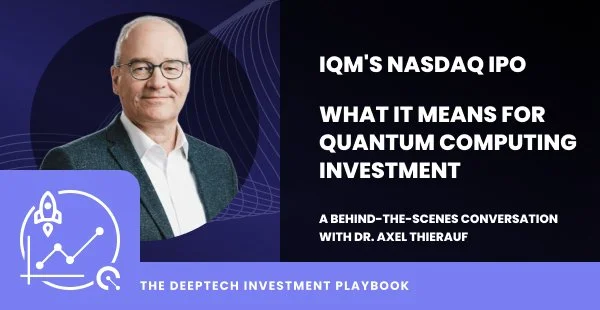
Dr. Axel Thierauf, GP at QAI Ventures, on IQM’s NASDAQ IPO
A Founder-Investor's Perspective on IQM's Nasdaq Debut
You've backed IQM since its earliest days as an investor and Chairman of the Board. Now that IQM is trading on Nasdaq, how does this moment feel?
“It's a fantastic experience. As an investor, that's essentially the goal: to bring a company to the capital markets within a reasonable timeframe. And this is definitely the fastest IPO I've experienced so far: seven years from founding to Nasdaq listing, and then such a fulminant listing on top of that. That's really something extraordinary. You don't see that often in Europe, and honestly, not that often in the U.S. either. Very exciting.”
The Quantum Computing Investment Thesis Before the 2019 Boom
You invested in IQM in July 2019, just months before Google's Sycamore experiment that September put quantum computing on the map. What made you back it before most investors were paying attention?
“That was in the summer, in July 2019, before Google showed its Sycamore experiment that September. At that point, quantum wasn't really on the radar of investors and the financial markets yet. Then Google came along in the fall, and that's when the big boom really started.
I've been a deep tech investor for 25 years, and I'm always looking for new trends. Every venture capitalist does that. At the time, quantum computing technologies were already quite advanced, so it was actually clear that within eight to ten years, which is how a venture capitalist thinks, this would be a very exciting story. And that turned out to be true. If anything, we're building even faster than expected.
That's really the big challenge in venture capital: finding the next big thing. Back then, the timeline was exactly that: the investment thesis was that the technology had reached a certain technology readiness level, and that real economic breakthroughs should happen within the next eight to ten years. And that's exactly what happened. That was the thesis, and it held.
It's actually very comparable to BioNTech. I was on the investment team at BioNTech back in 2009, and we bet on synthetic proteins back then. At that point it was already technologically possible, but everyone said the economic success just wouldn't materialize. And then COVID happened. And that was a massive success.”
What Could Trigger Quantum Computing's Breakout Moment
If COVID was the moment that validated the BioNTech thesis, what's the equivalent trigger you're watching for in quantum computing?
“That's going to happen very quickly. In our venture building program, we are already exploring solutions for fraud detection in banking. That's one of the biggest fears banks have. Another important topic is cybersecurity. This is not only relevant for financial institutions but also for assets like Bitcoin. And it's foreseeable that there will be the first major attacks that are quantum-computer-assisted. That's going to be a huge bang, because the banking industry, the financial industry, is the largest market in the world, and it's driven by trust in secure digital flows. An intruder from the quantum space is going to completely upend that.
That's actually the kind of threshold that managed capital is always looking for. It's clear it's coming: it's just a question of engineering at this point. Technologically, you can already see today that it's feasible. You just have to scale the computers up so they're big enough to actually function at that level, because they already work, but you need them to be able to actively manipulate these trillions of data streams. And once you equip attackers with systems like that, you also need defenders. Every bank in the world, every financial services provider, will have to upgrade its encryption systems with new cryptographic standards in the next two, three years: namely, Post Quantum Cryptography and Quantum Key Distribution. That's a massive industry in itself. So that's what I think the big bang will be.”
What Makes a Deep Tech Founder Investable
When you first met Dr. Jan Goetz and IQM's founding team, what convinced you this was a team worth backing?
“The five most important reasons to invest at the early stage, and this is exactly what we do at QAI Ventures too, three out of five come down to team, team, team. And that's what we had here: a complete team. The founding team was four co-founders, all four of whom already had experience in the field. On top of that, they had another group of almost 20 people who were working at various companies, including Microsoft, and who had already committed to joining the company once the initial funding came through.
So right from the start, you had a very experienced team, a management team that could really put the company on its feet immediately. And that's the decisive factor at the early stage. It's exactly what we try to enable now through venture building and our accelerator program too, because the team is everything. You can, in a pinch, even swap out the technology. But the team is everything.”
Investing in University Spin-Out Deep Tech Companies
IQM is often described as a university spin-out. What makes spin-outs like this challenging for investors, and what did IQM get right?
“The challenge with spin-outs is, well, this wasn't actually a full spin-out. One of the founders was, and still is, a professor at Aalto University. Jan Götz was a postdoc there. But the other two came from companies. These were four friends who had studied physics together and done their PhDs together. And the challenge with university spin-outs is usually the IP.
You have to make sure the IP actually goes with the company, and Aalto University was very professional about that. We were able to put that into contracts really well and really fast. I'd honestly wish other universities could match that same speed when it comes to licensing, selling, or setting up a cooperation agreement for the IP on certain topics. That's definitely a big challenge.”
Is Quantum Computing Investment-Ready?
With IQM now listed on Nasdaq, has quantum computing become a mainstream, investable asset class, or is it still niche?
“The segment is still relatively small. We're maybe talking about three handfuls of companies that are publicly listed in this space. And it's very strongly hyped: you can see that, because it's not being measured by earnings, by market cap relative to actual results, but by the future. Quantum is being seen as part of this AI hype: it's essentially the next big thing within the AI hype.
You have to remember, quantum computers are hardware accelerators for supercomputers, and AI supercomputers in particular would benefit enormously from having a quantum processor, a quantum computer, as a hybrid computer, as a hardware accelerator. That's basically what's happening right now. This is a technical topic now, not really a scientific one anymore. You're not waiting for scientific breakthroughs anymore: you just have to do it. That's the challenge now. But that's exactly why the sentiment is so hyped, because people see themselves as part of the bigger AI story, the big AI investment.”
Why NVIDIA's Endorsement Is a Market Signal for Quantum
Comparing 2019 to today, what's different about investor sentiment, and what market signals stand out to you?
“The key signals are coming from NVIDIA, which has gotten a lot more engaged in the quantum space. That started last year with the first announcement, and this year they've said very clearly, at several trade shows and technology conferences, that quantum is the next big thing. And that fuels the markets, of course: NVIDIA is the most valuable company in the world. The whole segment around memory chips, around the entire energy footprint in AI, is extremely profitable. It generates enormous cashflow. And that cashflow gets invested: people are looking for the accelerators for the next wave.
That's a cold, clear logic of financial investors, of the capital markets. It doesn't actually have anything to do with the technology itself, initially. The current status, as I said, still has to be reconciled with expectations at some point. But right now, it's being very clearly fueled by the big players in AI.”
SPAC Merger vs. Traditional IPO: How IQM Went Public
IQM went public through a SPAC merger rather than a traditional IPO. Does the route actually matter for investors?
“It's always a question of sentiment, but also a question of speed. With a SPAC, I can get to the public markets very, very quickly. IQM ultimately took about six months to get listed: the Business Combination Agreement was signed at the end of November, and then it was six months to listing. You can achieve that with a fast-track IPO too, but with a traditional IPO you're always heavily dependent on what's happening in the overall markets and in your segment at that moment.
The SPAC gives you a certain level of protection, because it already brings a certain share of investors with it, the so-called trust investors and PIPE investors, who have already committed something in the range of 200 to 300 million once the listing succeeds. You don't have that with a normal IPO. With an IPO, you're really dependent on whether you catch a good day or a bad day: how are the markets trading, how do you fit into the segment right now. It's very much driven by current conditions. The SPAC route, by contrast, is announced: there's a lot of communication, investors get to prepare for it. And a SPAC itself is essentially a listed shell that gets merged into. Regulatorily, it's also a good vehicle.
The downside, though it's also a feature, is that SPAC investors can decide, up until a week before listing, whether they want to participate or not. Redemption is always a big topic. For IQM it was mixed, around 50%, which is fine. There have been SPACs with 80 to 90% redemption that almost failed as a result. That's actually why a large share of SPACs over the last six or seven years never made it to listing at all.
In the quantum space, though, you've got different fundamental data, because the sector is being pushed hard by the AI hyperscalers and there's a lot of cashflow around. So it was the right vehicle here. There are more SPACs in the pipeline too: Pasqal, for example. There's also one company that went public via a traditional IPO: Quantinuum. So there's more coming, or already running, and it just brings more volume into the overall sentiment.”
What Determines Whether a Deep Tech Startup Scales Successfully
Looking back at IQM's journey, what are the critical moments that determine whether a deep tech startup scales, or doesn't?
“I'd say, especially when you're looking at the startup phase in quantum, and very concretely at IQM's own journey: a company that's cash-negative, which is most deep tech companies because they're pouring money into technology and often don't even have revenue yet, whereas IQM does have revenue, that kind of company always needs fresh capital. And that fresh capital comes either from equity investors like us, from larger venture capital investors, or eventually from international investors on the capital markets.
And you have to be prepared for that. You need good investor relations. You need to explain to the market why you're a good stock, what the opportunity is, because you're generating returns, how big those returns are, how big the market segment is. So on top of the actual work an entrepreneur has, building the business, you also always have to keep an eye on the capital markets. That's a real challenge for every young company, especially for people doing it for the first time. It's always difficult.”
Spotting the Next Quantum Computing Investment Opportunity
Looking ahead, is there a company or technology today that reminds you of IQM's early years? A potential “next IQM”?
“In the quantum space, the quantum computing side is maturing: meaning a whole industry is developing, not just the system manufacturers. IQM is a full-stack manufacturer. At the end of the day, there'll maybe be two handfuls of those, roughly. It's going to differentiate. IBM has already spun its unit out: it's becoming independent. The capital markets will understand it better, understand the business better, that way.
But across that supply chain, a whole range of young companies are emerging, and we're investing in those too: companies working on error correction, on scaling, and on the software side that will actually make these computers usable in a sensible way. That's a genuinely exciting segment that's developing right now. Think about how Microsoft started out, coming out of the operating system. How influential is the operating system? What applications exist on top of it: think Office. The same kind of thing is going to happen in the quantum computing space. And it'll be exciting to see who contributes to that. We definitely have several companies in the portfolio that will own certain pieces of that. So yes: there's a maturing of the ecosystem happening, and that's completely normal when a new industry is being born.”
Interested in more insights?
Join us on September 17 at the Quantum Global Summit, where Axel Thierauf will take part in an Ask Me Anything session.