
By Nadine Kugler, QAI Ventures
How do we move from isolated breakthroughs to coordinated systems that actually solve the world's hardest problems? At the ITU AI for Good Summit in Geneva, QAI Ventures discussed this consequential questions in advanced technology. The room included technologists, researchers, corporates, investors, and policymakers from across geographies, precisely the cross-sector gathering the moment requires.
Quantum and AI: Distinct, Not Interchangeable
Before discussing systems change, one misconception needs to be cleared up: quantum computing and AI are separate technologies. They are not converging into a single field.
That said, they intersect in three meaningful ways.
In security, the explosion of AI-driven increased data exchange demands more secure networks, and quantum technologies, including post-quantum cryptography and quantum key distribution, are part of the answer.
In algorithms, quantum machine learning combines classical and quantum computing to tackle specific sub-problems that are intractable for either alone.
And in hardware development, AI is now being used to optimise the control systems that run quantum computers themselves.
The strategic implication for innovation leaders is this: don't ask whether to invest in AI or quantum. Ask where in your technology stack quantum capabilities could take performance to a level classical computing cannot reach.
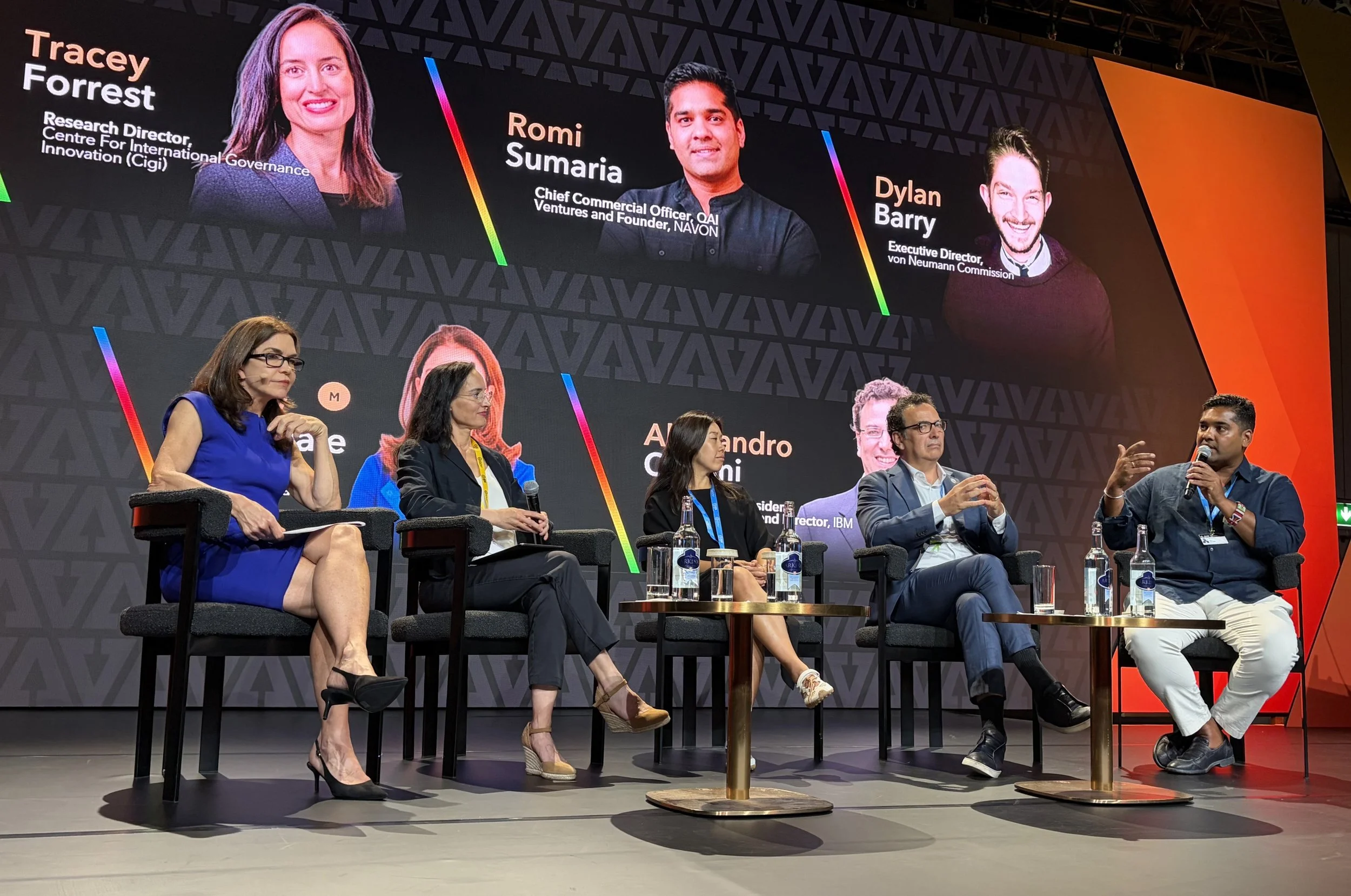
Panel “Quantum and AI: Unlocking new frontiers through Convergence” at the AI for Good Summit.
Where Quantum Creates Real Impact
Quantum technology is not a general-purpose solution. But there are four domains where the case is compelling, not because quantum is fashionable, but because the underlying problems are genuinely intractable with today's best classical tools.
Healthcare and life sciences. Quantum sensing is enabling new modalities for measuring biological systems with precision previously unavailable. On the computational side, quantum machine learning is being applied to sparse-data problems like clinical trial drug dosage safety, where patient cohorts are too small for conventional AI to function reliably.
Climate and energy. Quantum computing applied to chemistry enables the discovery of new materials for batteries and catalysts for clean energy, problems that require simulating molecular interactions at a scale that overwhelms classical hardware.
Agriculture and food security. Better materials science, improved sensing, and more accurate optimisation models feed into agricultural productivity and supply chain resilience.
Water and infrastructure. From new water treatment catalysts to stress-testing grid infrastructure under high renewable penetration, quantum computing offers new capabilities current classical simulations cannot match.
The Ecosystem Gap Is the Real Bottleneck
The technology is advancing. The challenge is systemic.
Momentum is building: $3.8 billion in venture capital invested in quantum in 2025 alone, more than 30 national quantum strategies, $56 billion committed from governments worldwide, and an estimated 250,000 jobs yet to be created in the sector. But momentum is not the same as impact. Four structural gaps remain.
Capital concentration. Private quantum investment is heavily concentrated, primarily in the United States, at a scale categorically different from the rest of the world. Without mechanisms to mobilize capital across borders, the global ecosystem will calcify around existing centers of wealth, pulling talent and IP with it.
Talent scarcity. The skills quantum requires, physics, mathematics, algorithm design, are not yet being produced at scale. Workforce strategy in advanced computing must be built now, including outreach well beyond leading universities. For example Kenya's universities are already running quantum projects. They need resources and pathways, not just recognition.
Geopolitical fragmentation. Export controls, dual-use concerns, and increasing national defensiveness around deep technology are real constraints. The challenge is maintaining security without foreclosing the cross-border collaboration that gives quantum its global impact potential.
Access inequality. The problems quantum can help solve, disease, water, food, climate, are global. Beyond optimise systems that already work, Quantum holds the potential to develop solutions for the worlds hardest problems.
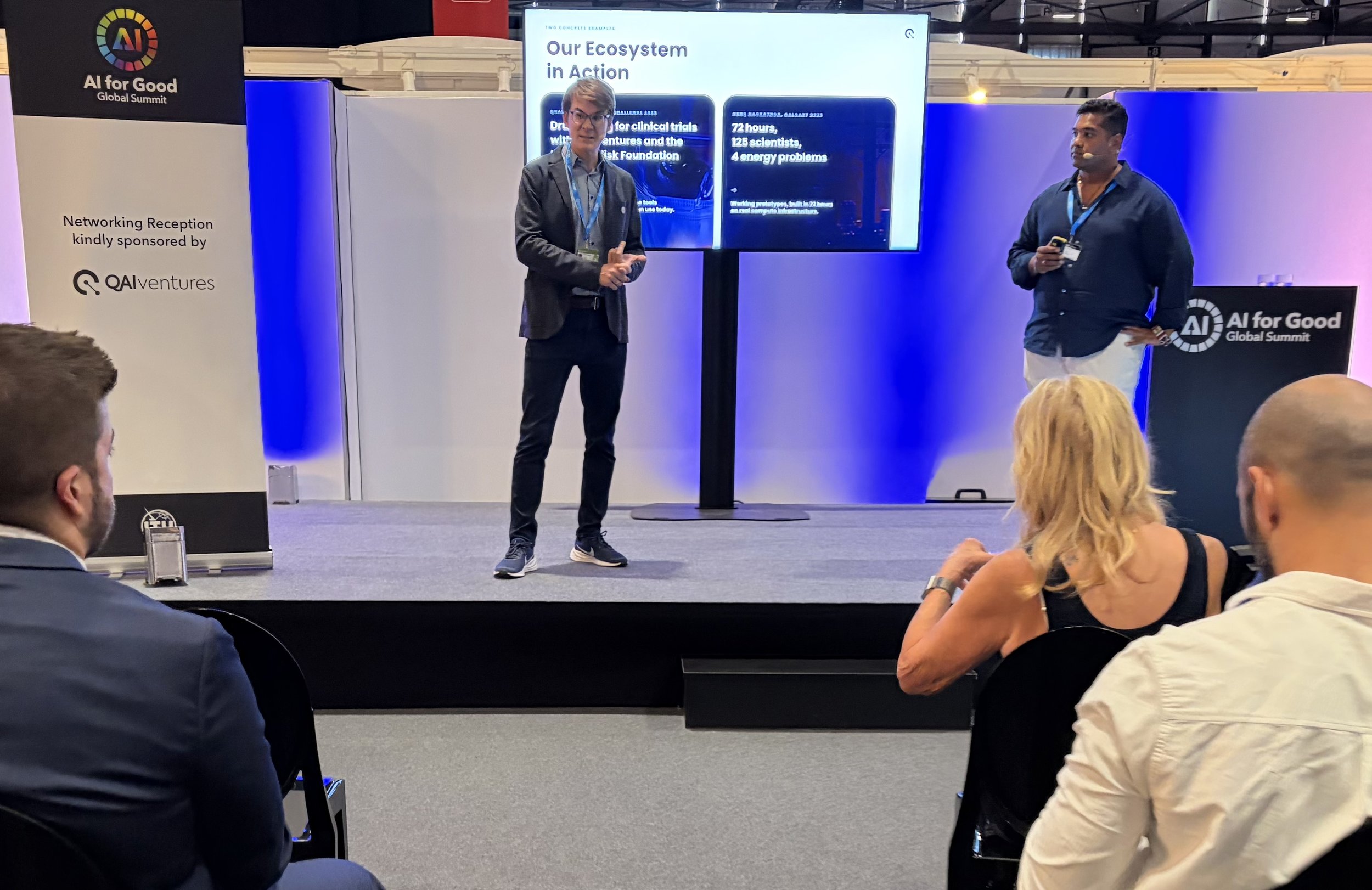
Dr. Tobias Denzler, Global Head of Science & Technology & Romi Sumaria, Chief Commercial Officer at the AI for Good Summit.
What Multi-Stakeholder Collaboration Actually Looks Like
At QAI Ventures, our thesis is that ecosystem is the engine. In practice, this means structured programs that connect the right problem owners with the right technical capabilities.
We have run hackathons in Geneva, Calgary, and Singapore, 48-hour formats co-designed with industry partners around concrete, unsolved problems. The Geneva edition focused on energy: materials for next-generation batteries, load forecasting in electric grids, and grid stress-testing under renewable penetration.
Our global innovation challenges run four to five months, fully online, enabling teams from any geography to compete. Our most recent challenge initiated by QAI Ventures Portfolio company MQS co-designed with the Bio Innovation Institute, the Danish Business Authority, Roche and Novo Nordisk, tackled clinical trial drug dosage safety, a domain where sparse patient data makes conventional AI unreliable. Finalists from Imperial College London, UCLA, and the University of Busan developed quantum machine learning approaches to the problem, with results being prepared for publication. The online format matters: it removes the geographic filter that physical events impose and creates access for teams that would never reach a Geneva shortlist.
Engage Early or Catch Up Later
Quantum computing is reaching broader deployment through cloud access and enterprise installations, likely following the trajectory of high-performance computing. The first meaningful phase runs through research institutions and testbeds. Companies like QCentroid, a QAI Ventures portfolio company, are already making algorithm development accessible at low cost, enabling teams in any geography to begin building capability before hardware becomes widely affordable.
The question for innovation leaders is not whether quantum will arrive. It will. The question is whether your organisation will be positioned to use it, or scrambling to catch up when the leaders in your sector already are.
The organisations that will capture the most value are not necessarily those with the largest R&D budgets. They are the ones building the right relationships now, with startups developing foundational tools, researchers identifying applicable use cases, and ecosystem partners that can translate scientific capability into deployable solutions.
The decade for quantum technology has begun. The window to engage strategically is open.

Your contact
Romi Sumaria
Chief Commercial Officer, QAI Ventures
Contact via Email